

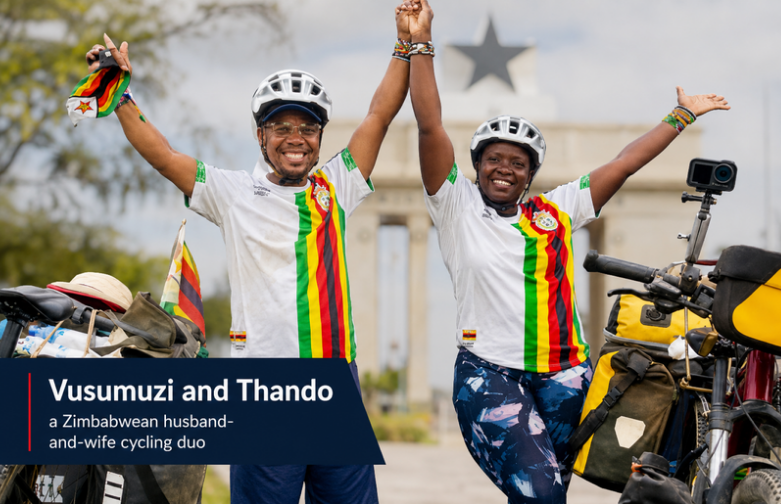
AFRICA’S BORDERS UNDER SCRUTINY AS ATB ENGAGES CYCLING COUPLE ON PAN-AFRICAN TOURISM MISSION
 JOHANNESBURG / ACCRA — For decades, the halls of continental governance have echoed with passionate rhetoric championing pan-African integration, the African Continental Free Trade Area (AfCFTA), and the utopian promise of a borderless continent. Yet, for the average citizen, the reality of moving across Africa remains a bureaucratic and logistical quagmire defined by exorbitant visa fees, hostile border officials, fragmented financial networks, and colonial-era linguistic divides.
Now, an extraordinary grassroots intervention has thrust this structural contradiction back into the political spotlight. Armed not with institutional mandates but with bicycles, sheer endurance, and raw lived experience, a Zimbabwean husband-and-wife cycling team has forced a reckoning within Africa’s diplomatic corridors.
Vusumuzi and Thandolwenkosi (Thando), whose grueling trans-African journey has seen them cross 22 countries and 22 border posts, are no longer viewed merely as endurance athletes. They have rapidly emerged as potent citizen diplomats exposing the friction points of Africa’s unfinished integration project—and continental leadership is taking notice.
In a strategically significant alignment of tourism leadership, trade integration experts, and diplomatic stakeholders, the Chumas’ travel anecdotes have been elevated into actionable political intelligence. Moving decisively to harness this momentum, Cuthbert Ncube, Executive Chairman of the African Tourism Board (ATB), has formally designated the cycling couple as Africa Brand Ambassadors. The appointment signals a deliberate shift by the ATB to utilize the couple’s journey as a spearhead for continental advocacy aimed at dismantling the barriers paralyzing Africa’s unified tourism economy.
“The timing of this mission could not be more significant,” Ncube stated, positioning the cyclists’ experiences as empirical evidence of the chasm between high-level policy ambition and ground-level implementation failure. “We stand ready to facilitate your next leg. We will engage our local chapters to receive and host you. You are now our Africa Brand Ambassadors.”
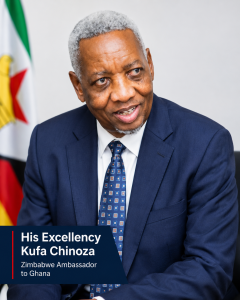
The endorsement marks a critical transition: what began as an independent test of human endurance has officially entered the realm of institutional diplomacy. The geopolitical weight of the Chumas’ mission was underscored on May 17, 2026, when they were officially received by His Excellency Ambassador Kufa Chinoza, Zimbabwe’s Ambassador to Ghana. Ambassador Chinoza, a staunch proponent of commercial diplomacy, subsequently joined a virtual strategic session to offer firm political backing. He praised the couple for projecting a resilient Zimbabwean brand across the continent through tangible action rather than speeches, challenging Africa’s youth to replicate such disciplined, purpose-driven initiative.
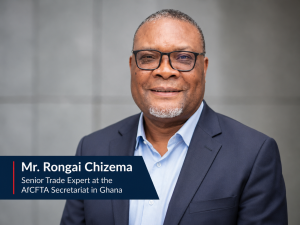 Perhaps the most pointed analysis came from Rongai Chizema, Senior Trade Expert at the AfCFTA Secretariat in Ghana and former Chief Technical Advisor at the African Union Commission’s Department of Trade and Industry. Stripping away any romanticized sports framing, Chizema classified the Chumas’ journey as a vital exercise in economic intelligence gathering. By navigating 22 borders without commercial sponsorship or institutional cushioning, the Chumas inadvertently conducted exhaustive, evidence-based field research on the operational dysfunctions confronting African travelers, informal traders, and regional operators.
The Chumas’ findings exposed four structural crises that traditional diplomatic communiqués frequently obfuscate. First is mobility exclusion, characterized by strict, non-reciprocal visa regimes where Africans are routinely treated with suspicion within their own continent. Second is digital isolation, driven by rigid, fragmented SIM registration rules that leave cross-border travelers disconnected and economically invisible. Third is financial fragmentation, where a stark lack of payment interoperability forces a reliance on volatile foreign currencies and informal exchange networks. Finally, infrastructure neglect ensures that transport corridors remain built exclusively for heavy cargo, leaving them actively hostile to sustainable, human-centric movement.
“This is a rare feat,” Chizema observed, noting that the findings expose a severe disconnect between the aspirations of AU Agenda 2063 and operational realities. The prohibitive cost of visas, he argued, remains a direct embargo not just on tourism, but on commerce itself. The political calculus is clear: if movement is restricted, trade is constrained. If trade is constrained, integration remains a fiction—and Africa’s broader economic ambitions become fundamentally compromised.
For the African Tourism Board, the Chumas’ journey has transformed tourism from a marketing exercise into a political battlefield for mobility reform. The core contradiction remains glaring: Africa aggressively invites the global north to visit, yet structural policy failures prevent Africans themselves from moving with ease, affordability, or dignity across their own continent.
Vusumuzi and Thando Chuma did not set out to become policy advocates. However, by simply attempting to traverse the continent, they have mapped the precise distance between political promises and lived reality. In doing so, they have forced a question that African policymakers can no longer afford to evade: if Africa cannot move Africa, what exactly does integration mean?
You can see more details regarding the third season of their continental itinerary in this video titled Introducing our Season 3 Cycling from Zimbabwe to Nigeria as a Couple. This video provides context on the upcoming leg of their journey through Central and West Africa, reflecting their continuing transition into continental advocacy figures.